Lintong, near the site
Saves the 90-minute transfer and lets you be first through the gate. Quiet town, few restaurants.
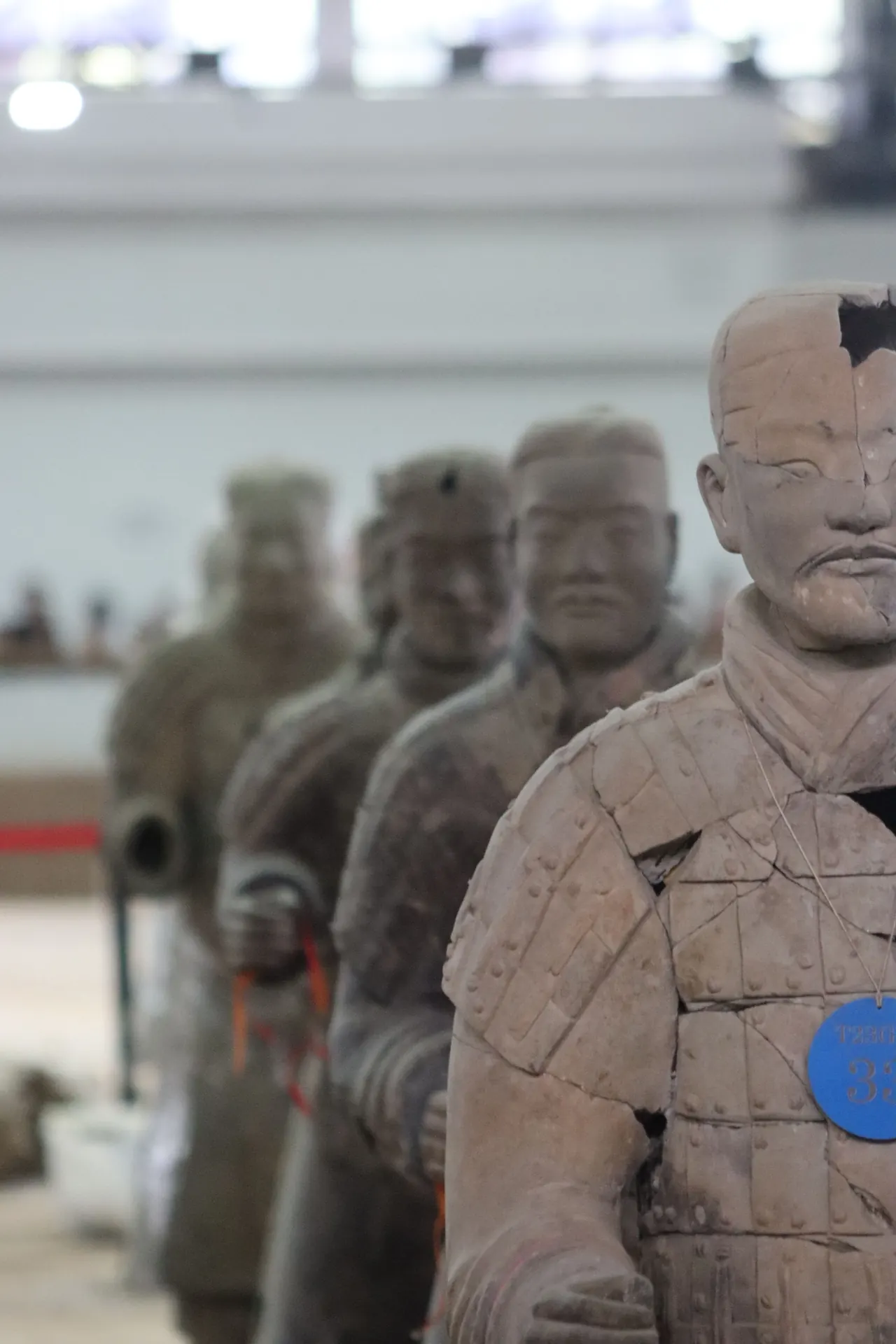
It is one of the few archaeological sites in China where you can see an entire army — ranks, horses, chariots, individual faces — still standing where it was buried in the third century BC.
Reservation: required before you go
Real-name timed reservation. Foreign visitors, including passport holders, book through the official website or the two official WeChat accounts and must present the original passport at the check-in gate. The English site's 'Ticket' button currently links to Trip.com — authorisation and price parity are unconfirmed, so use the official channels. Peak dates follow the Chinese official page (16 Mar–15 Nov); the English site's 1 Mar–30 Nov is outdated. One ticket covers both the Terracotta Warriors Museum and Lishan Garden; both sites stop check-in at 17:00.
Chinese address card · 中文地址
秦始皇帝陵博物院
陕西省西安市临潼区秦陵北路
Taxi drivers know it as 兵马俑. Show the Chinese name, not the English one.
Address precision: street
It is one of the few archaeological sites in China where you can see an entire army — ranks, horses, chariots, individual faces — still standing where it was buried in the third century BC.
Pit 1 is the postcard. Pit 2 is where the specialists are still excavating. Pit 3 is small and easy to skip if you are short on time.
The site is a park, not a building: you will walk 2–3 km between pits, mostly in the open. In summer, bring water and a hat; in winter, the halls are unheated.
Written and fact-checked for this page; the data modules above stay the source of truth for hours, tickets and reservations.
The Terracotta Army is a half-day visit wrapped in a ninety-minute transfer, and almost every planning question about it is really a logistics question: which season you are in, which document you book with, whether you are doing one site or two, and how you are getting back. Sort those out and the site itself is easy — three excavation halls, a short walk between them, and the ranks of figures doing exactly what they were buried to do.
We checked the museum's Chinese and English pages, the official notice on the 2026 peak-season dates, the provincial pricing document and the transport page on 1 November 2026. Where the museum publishes nothing, this page says so instead of filling the gap.
The draw is not a single object but a formation: ranks of soldiers, horses and chariots standing in the pits where they were buried in the third century BC, each face modelled separately. Photographs flatten it. What they do not convey is the distance — this is a park, not a building, and you will walk between halls in the open, which matters in July and matters differently in January.
The museum is made of two sites, and this is where most itineraries go wrong. The Terracotta Warriors Museum is the famous one. The Lishan Garden (丽山园) is the archaeological park around the mausoleum mound, a separate site roughly a free shuttle ride away, and your ticket covers both. The museum's own guidance is about 1.5 hours at each. People who see just the pits have seen the army but not the landscape it belongs to, and they have also skipped the part of the visit that is quiet.
Two of the three halls are the reason to slow down: the large one everyone photographs, and the smaller ones where you can get close enough to read the detail in the armour and the faces. Hall assignments and which pits are open for viewing can change with excavation and conservation work, so check the museum's notices rather than any fixed itinerary, including this one.
By metro and bus (the documented route). Take Metro Line 9 to Huaqingchi (华清池) station, leave by Exit C, and transfer to bus 临潼游613 or 临潼602 to the Terracotta Warriors stop. This is the route the museum itself publishes, and it is the cheapest way to arrive without a tour.
From the airport. The museum's own route page puts the airport-to-site journey at about 2 hours 26 minutes to 2 hours 47 minutes. If you are landing and heading straight out, that is your realistic window, and it is not a connection to schedule tightly.
By taxi or ride-hailing. The museum publishes no taxi time or fare, and neither will we — on a good day it is quicker than the bus, on a bad one it is not, and the number changes with traffic. Use the app's own estimate when you book, agree the fare or meter before you set off, and say 兵马俑 (Bingmayong): drivers know the Chinese name, not the English one.
The return trip is the part to plan. Whatever you take out, decide how you are coming back before you go in. Buses back to the metro fill up in the late afternoon, and a visit that starts in the middle of the afternoon is a visit that ends near closing time with everyone else.
The season boundary is 16 March, and it moved this year. The museum issued a notice on 15 March 2026 confirming that peak-season check-in would start on 16 March, with first check-in at 08:30 and last check-in at 17:00. The Chinese-language guide says the same: peak season 16 March–15 November, off-season 16 November–15 March.
If you read the English version of the museum's site, you will find older dates — 1 March to 30 November, 1 December to 28 February. That page has not been updated to match the Chinese notices. It is the clearest example on this site of why we date things: the correct dates are the ones in the Chinese-language guidance and the 2026 notice, and the English page is stale.
Both sites stop check-in in the late afternoon, well before closing time. That single rule decides your day: a late arrival can see the pits or the Lishan Garden, not both. If you want both, start early. The daily cap is 65,000 visitors — the museum's current guide states it, though we did not find a 2026 notice repeating the number, so treat it as the published cap rather than a live counter. In practice, the morning window is the one that buys you the whole site without rushing, and a lunchtime departure from Xi'an is the latest sensible start for both.
Winter changes two things: check-in closes earlier, and the site closes earlier. It is also colder and emptier, and the halls are not heated. Summer is the reverse — the walk between sites is exposed, so water and a hat are part of the kit.
The visit has a shape, and it is decided by the shuttle and the clock. Do the Terracotta Warriors Museum first, in the morning while it is still cool and the halls are not full, then take the free shuttle to the Lishan Garden and finish there. Doing it in the other order means you are walking the pits when tour buses arrive and doing the quiet site when you are already tired.
At the museum, start with the largest hall and work through the smaller ones. The big hall is where the scale hits you, and it is also where everyone stops, so it makes sense to be there early and then retreat to the smaller pits, where you can actually get to the railing and see the detail.
At the Lishan Garden, the point is the landscape and the archaeology rather than another hall of figures, so give it a slower hour and stop trying to photograph everything. The shuttle runs between the sites, and the museum publishes the connection but not a timetable — plan on waiting rather than timing it exactly, and leave enough margin for the return to Xi'an. If you have just one afternoon in Lintong, skip the garden and keep the pits; if you have half a day, both sites are worth it.
Do I need to book in advance, and can I book with a passport?
Yes to both. Entry is real-name and timed; foreign visitors including passport holders can book on bmy.com.cn or the official WeChat accounts, and the original passport is checked at the gate. Book before the day you want to visit, especially around weekends and public holidays.
How much is admission?
The museum publishes no price on its own site. The CNY 120 figure comes from the 2018 provincial pricing document that cut the previous rates; confirm the current price on the official booking page or by phone before you rely on it.
How long does the visit take?
About 1.5 hours at the Terracotta Warriors Museum and 1.5 hours at the Lishan Garden, plus the transfer each way from Xi'an. Three to four hours on site is realistic if you see both.
How do I get there without a tour?
Metro Line 9 to Huaqingchi, Exit C, then bus 临潼游613 or 临潼602 to the Terracotta Warriors stop. A taxi or ride-hailing car is quicker on a good day; the museum publishes no time or fare for it.
Can I see everything in one afternoon?
If you arrive early enough to clear check-in at both sites before 17:00. Both stop check-in at 17:00, so a mid-afternoon arrival usually means choosing between the pits and the Lishan Garden.
Is the site open every day?
We are not making that claim. The museum posts closure notices, including on its English home page, and opening arrangements can change with conservation work. Check the notices before you fix a date.
Draft content — editorial review pending. Facts above still come from the verified data record.
Distance to the gate matters more than the star rating. Compare both options before booking.
Saves the 90-minute transfer and lets you be first through the gate. Quiet town, few restaurants.
Keeps your evenings. You lose the early start, but gain the food and the wall at sunset.
Allow three to four hours on site, plus about an hour each way from central Xi'an. Most visitors see all three pits in two hours and spend the rest queuing and walking.
Arrive at opening or after 15:00. Tour groups peak between 10:00 and 14:00, and weekends are noticeably busier than weekdays.
Yes. Tickets are sold online with a passport number and daily visitor caps apply. Book several days ahead in summer and around public holidays.
No reviews are published yet. We do not synthesise or import reviews from other platforms.
Reader questions
Discussion opens after launch, using Giscus (GitHub Discussions). Nothing is loaded or collected on this page yet.